Editorial:
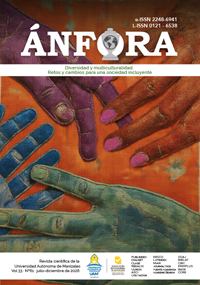
Diversity and Multiculturalism
DOI:
https://doi.org/10.30854/anf.1459Keywords:
inclusion, recognition, justice, memory, territory, multiculturalismAbstract
This monographic issue of Ánfora brings together socially relevant research and directs the focus of analysis toward subjects historically positioned at the margins. Its central premise is that inclusion, justice, and recognition cannot be understood solely in terms of material access, but also as matters of epistemic legitimacy, memory, territory, and dignity. Drawing on debates surrounding inclusive and multicultural education, gender perspectives, coloniality of knowledge, the rights of Afro-descendant communities, aging, youth, and historical memory, the text argues that Latin American democracies will be evaluated according to their capacity to expand the field of recognition within increasingly diverse societies. This editorial maintains that the margins are not external to the system, but rather spaces from which the system reveals both its limits and its possibilities for transformation. In this
sense, listening to marginalized voices constitutes a demand for truth, intellectual justice, and democratic renewal.
Downloads
References
Comisión Interamericana de Derechos Humanos (CIDH). (2021). Derechos económicos, sociales, culturales y ambientales de las personas afrodescendientes. Organización de los Estados Americanos. https://www.oas.org/es/cidh/jsForm/?File=/es/cidh/informes/tematicos.asp
Comité sobre los Derechos de las Personas con Discapacidad. (2016). Observación general núm. 4 (2016) sobre el derecho a la educación inclusiva (CRPD/C/GC/4). Naciones Unidas. https://www.ohchr.org/es/treaty-bodies/crpd
Crenshaw, K. (1991). Mapping the Margins: Intersectionality, Identity Politics, and Violence Against Women of Color. Stanford Law Review. https://blogs.law.columbia.edu/critique1313/files/2020/02/1229039.pdf
Fraser, N. (1998). Social Justice in the Age of Identity Politics: Redistribution, Recognition, and Participation. https://www.ssoar.info/ssoar/handle/document/12624
Fricker, M. (2007). Epistemic Injustice: Power and the Ethics of Knowing. Oxford University Press. https://doi.org/10.1093/acprof:oso/9780198237907.001.0001
Mbembe, A. (2019). Necropolitics. Duke University Press. https://www.dukeupress.edu/necropolitics
Naciones Unidas. (2018). United Nations Declaration on the Rights of Peasants and Other People Working in Rural Areas. https://digitallibrary.un.org/record/1650694?v=pdf
Organización de los Estados Americanos [OEA]. (2015). Convención Interamericana sobre la Protección de los Derechos Humanos de las Personas Mayores (A-70).
Organización de los Estados Americanos. https://www.oas.org/es/sla/ddi/docs/tratados_multilaterales_interamericanos_a-70_derechos_humanos_personas_mayores.pdf
Organización Internacional del Trabajo, y Fondo de las Naciones Unidas para la Infancia. (2021). Child Labour: Global Estimates 2020, Trends and The Road Forward. ILO & UNICEF. https://data.unicef.org/resources/child-labour-2020-global-estimates-trends-and-the-road-forward/
Organización Panamericana de la Salud [OPS]. (2021). Older Persons: A Human Rights-Based Approach. OPS.
Quijano, A. (2000). Coloniality of Power, Eurocentrism, and Latin America. Nepantla: Views from South, 1(3), 533-580. https://muse.jhu.edu/article/23906
UNESCO. (2020). Global Education Monitoring Report 2020: Inclusion and Education: All means all. UNESCO.
Downloads
Published
Issue
Section
License
Copyright (c) 2026 Luis Villafán Amezcua, Daria Mottareale Calvanese, Roberto Moreno

This work is licensed under a Creative Commons Attribution-NonCommercial-ShareAlike 4.0 International License.
Once the manuscript is approved, the authors should file and sign the Right Transfer Format.